
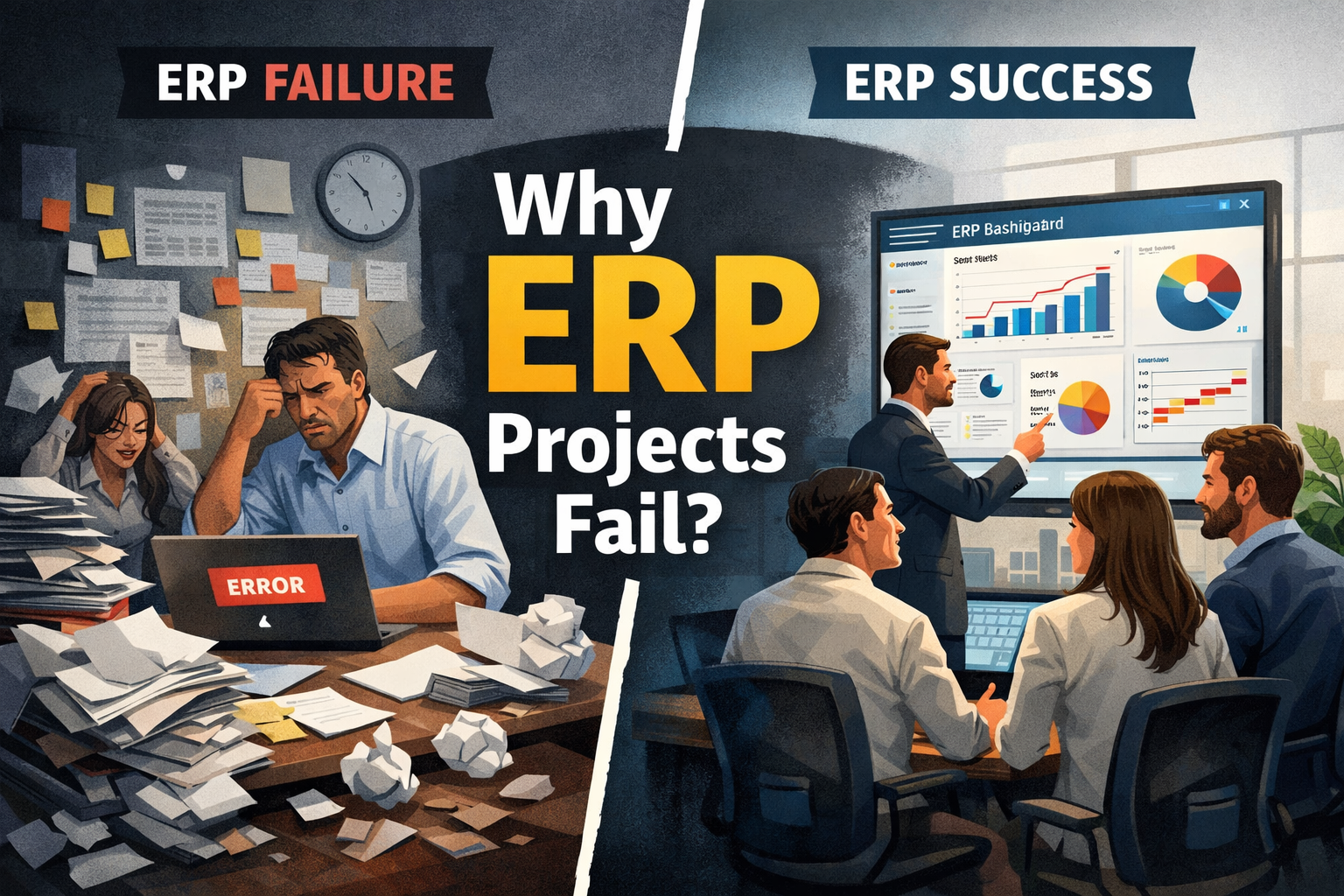
ERP implementation is often seen as a gamechanger for businesses—especially in the pharmaceutical industry, where compliance, accuracy, and efficiency are critical.
However, many ERP implementation projects fail to deliver expected results.
Why does this happen?
The problem is not the software—it’s the approach.
At PharmaVerge ERP, we have observed that successful ERP implementation depends more on strategy, adoption, and mindset than just technology.
Let’s explore the most common reasons why ERP projects fail—and how to avoid them.
1. Lack of Management Involvement
One of the biggest reasons for ERP implementation failure is when leadership treats it as just an IT project.
Management often says, “Let the team handle it.”
But without leadership involvement, the project lacks:
- Clear vision
- Faster decision-making
- Cross-department alignment
Solution:
Leadership must actively participate and drive the ERP initiative from the top.
2. Treating ERP as Just a Data Entry Tool
Many companies misunderstand ERP as only a data entry system.
In reality, a modern ERP software for pharma companies is designed to:
- Automate processes
- Provide real-time business insights
- Improve decision-making
If ERP is used only for data entry, its real value is lost.
Solution:
Focus on using ERP reports and analytics for decision-making.
3. Lack of Training at Management Level
In many organizations, only operational teams are trained on ERP systems.
This creates dependency on specific employees.
When they leave, the ERP knowledge goes with them.
Solution:
Ensure ERP training for management and decision-makers so that knowledge stays within the organization.
4. Continued Dependence on Manual Processes
Even after ERP implementation, many companies continue using paper-based systems.
This slows down digital transformation and reduces efficiency.
ERP systems offer:
- Faster data access
- Better accuracy
- Improved data security
Solution:
Adopt a digital-first approach and reduce dependency on manual processes.
5. No Change Management Strategy
ERP implementation is not just a system change—it’s a people change.
Employees resist change when:
- They are not informed
- They are not trained
- They are not supported
This leads to low adoption and eventual ERP failure.
Solution:
Implement proper change management in ERP projects with continuous support and communication.
6. Using Multiple Software Systems (Lack of Data Integration)
Many companies use different software for accounting, inventory, production, and sales.
While this may seem manageable initially, it creates major challenges:
- Data is scattered across systems
- No single source of truth
- Difficulty in generating accurate reports
- Increased chances of errors and duplication
As a result, management never gets a complete business picture in one place, which leads to poor decision-making and contributes to ERP failure.
Solution:
Implement a centralised ERP system where all departments work on a single platform with integrated data
7. No Time for Practice After Training
Training alone is not enough.
In many ERP projects, users are trained once and immediately expected to start working on the system without enough practice time.
This leads to:
- Low confidence among users
- Errors in data entry
- Resistance to using the system
Without hands-on practice, adoption becomes weak—even if the training was good.
Solution:
Provide sufficient practice time, sandbox environments, and continuous support after training to ensure users are comfortable with the system.
How PharmaVerge ERP Helps You Succeed
At PharmaVerge ERP, we go beyond just software implementation.
We help pharmaceutical companies:
- Achieve department-wise visibility
- Track real-time data for better decisions
- Ensure smooth user adoption
- Align ERP with business goals
Our approach focuses on successful ERP implementation, not just deployment.
Conclusion: ERP Success Depends on the Right Approach
ERP is not just a tool—it’s a transformation.
Businesses that succeed with ERP:
- Involve leadership
- Focus on adoption
- Use data for decision-making
ERP doesn’t fail. The strategy behind it does.